What makes a delivery backpack different
A food delivery backpack is loaded and unloaded many times a shift and worn on a bike, scooter or motorcycle. It needs more structure and support than a picnic cooler with shoulder straps, and it is a different bag from an office backpack. “Insulated backpack” alone is not enough for an accurate quote.
State, in the brief:
- The route: bicycle, scooter, motorcycle or on foot; how long a typical run lasts; and whether the bag is worn the whole time or is also set down at a door.
- The load: the actual containers — pizza boxes, meal trays, drink cups or cans, and whether they must stay upright and separated.
- Which failures would make it unsuitable: a box that slumps in a turn, a zipper that is awkward with gloves, a strap that cuts in when the bag is full, or a lining that is hard to wipe after a spill.
The cooler bag guide covers picnic and outdoor coolers, and the insulated lunch bag guide covers a smaller meal bag. This page is for rider or fleet delivery.
Start with the route and the load, not a litre number
Capacity in litres is only useful if it is tied to the real items. A litre figure does not tell you whether a stack of pizza boxes will sit flat, whether a drink will stay upright, or whether a tray will slide when the rider turns. List the items first, then size the bag from that list.
If you have a reference model, use its published outside dimensions as a starting point, and still confirm the interior with the actual containers. Our YS-DL01 is listed by outside size (37.1 × 26.9 × 48 cm), not by litres. If you need a litre figure for your own listing, ask us to measure it on the sample.
For the first brief, include:
- The containers that must fit, with their size if you have it, and how they are stacked.
- Whether hot food, cold drinks, or both go in the same bag, and whether they must be kept apart.
- How often the bag is opened on a typical shift, and whether the rider needs to take one item out without emptying the rest.
Access: top, front, or both
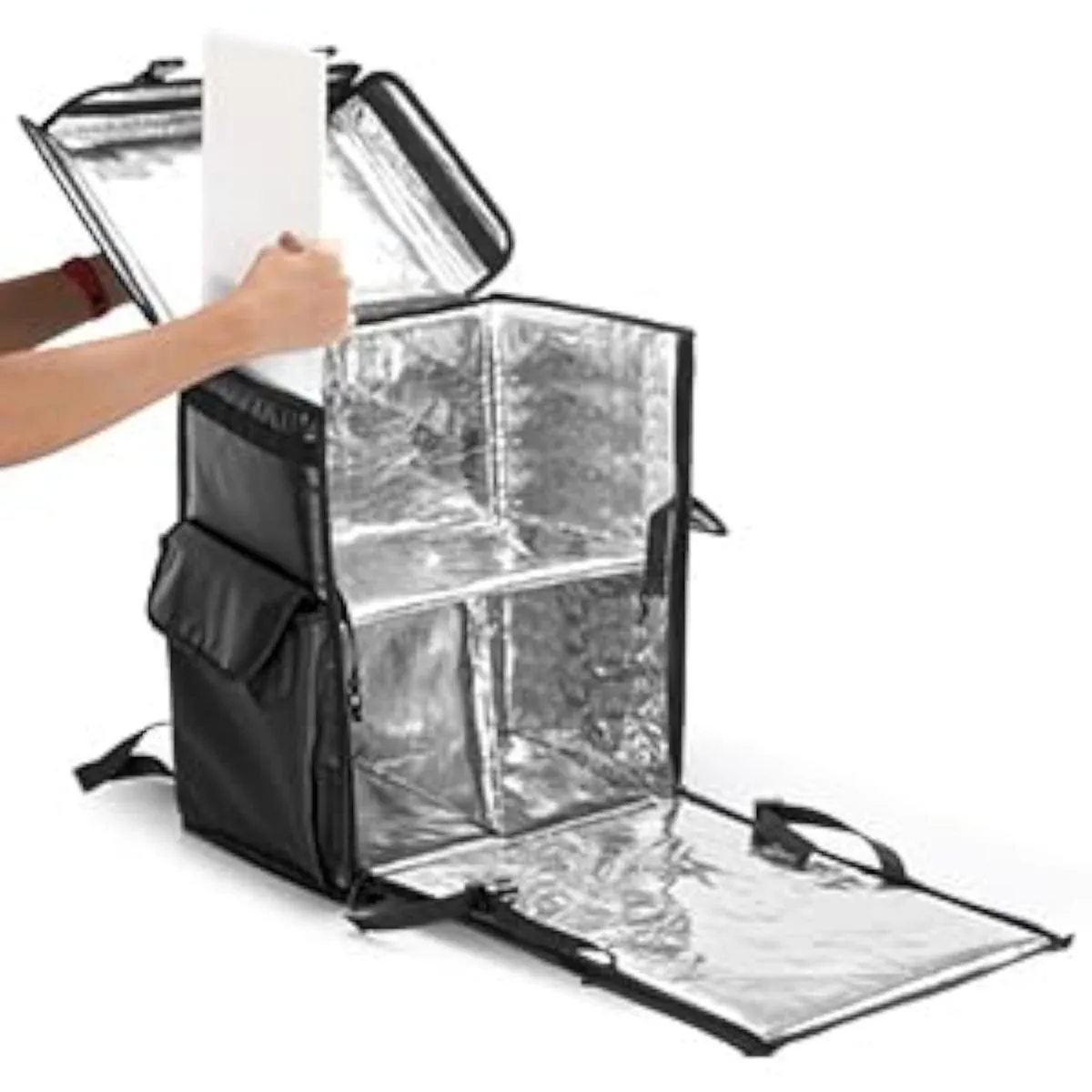
How the bag opens changes loading speed and how easily a stack stays in place.
- A top opening is the straightforward way to lower a stack in and lift it out. It can be slower at a door if the rider has to open the whole top to reach a lower item.
- A front opening lets the rider reach into the compartment from the side that faces away from the back. It is useful when the bag stays on the body, or when a divider or support board has to be inserted or removed.
- Top and front together give two ways in. On the published delivery backpack on this site, the top and the front both open, so a support board can be put in while the foil-lined interior is visible.
Write down which openings you need, and test them on the sample with the real containers, not with the bag empty. Check that zippers still run when the compartment is packed, and that a board or divider can be moved without tearing the lining.
Insulation, lining and support boards
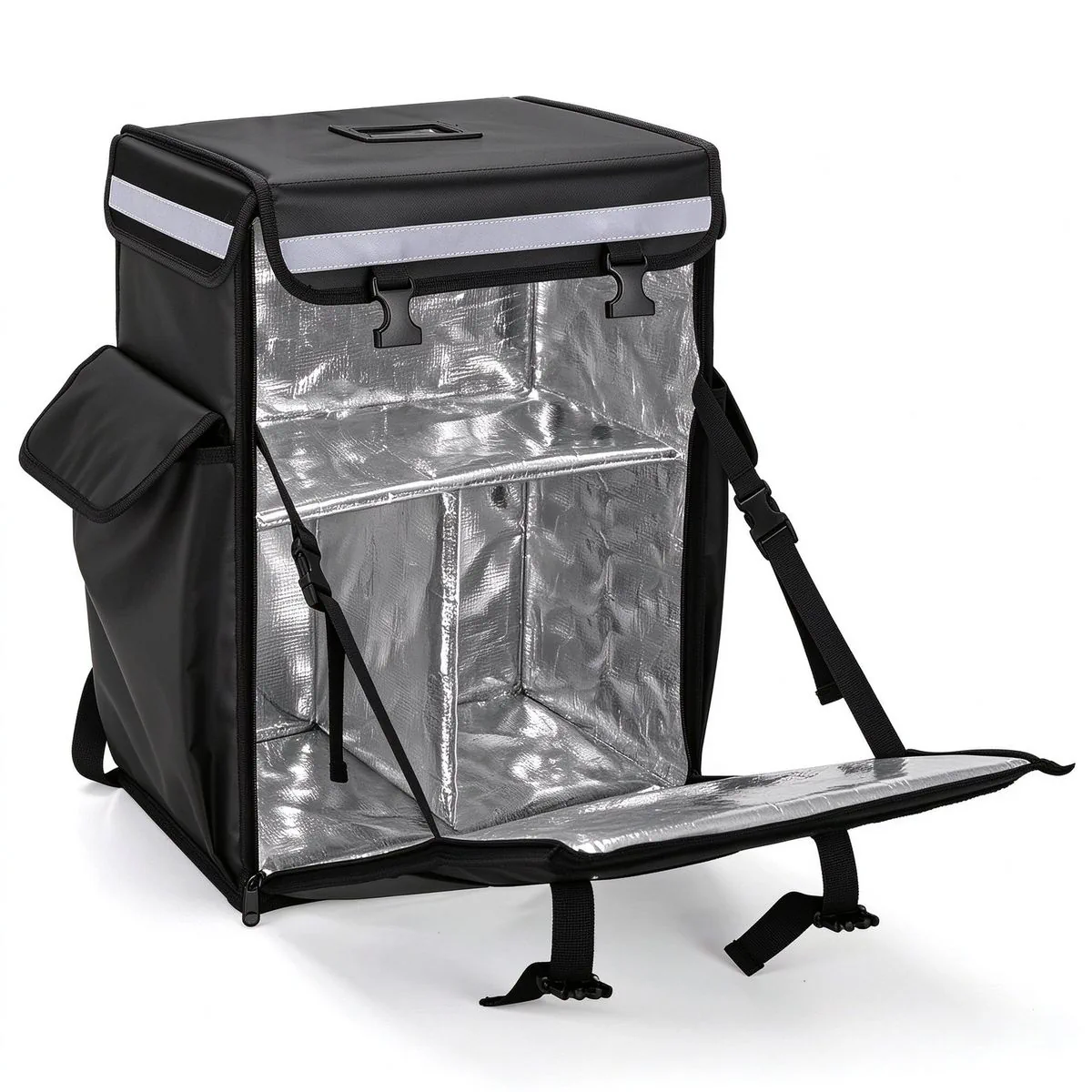
Insulation is the layer that slows heat transfer. On the published delivery backpack, this is PE foam — a plastic foam panel — behind a wipe-clean aluminum-foil lining. Other constructions may use a different insulation build. If a destination market requires a named insulation or a food-contact lining, write that into the brief and confirm it on the sample; do not assume every foil-looking lining is the same material.
The lining has to be wiped after a spill. On the sample, check that seams and corners can actually be cleaned, and that the foil face does not crack or peel at the fold lines after the bag has been opened and closed repeatedly.
Dividers and support boards are what keep a stack from slumping. The published reference has a three-section main compartment, removable dividers, and two support boards. Say how many sections you need, whether dividers must be removable, and whether boards must stay rigid when the bag is full. On the sample, load the real containers, close the bag, and tilt it as a rider would in a turn. Watch whether the stack leans, and whether a board can be taken out and put back.
Rider carry: straps, chest buckle, reflective details
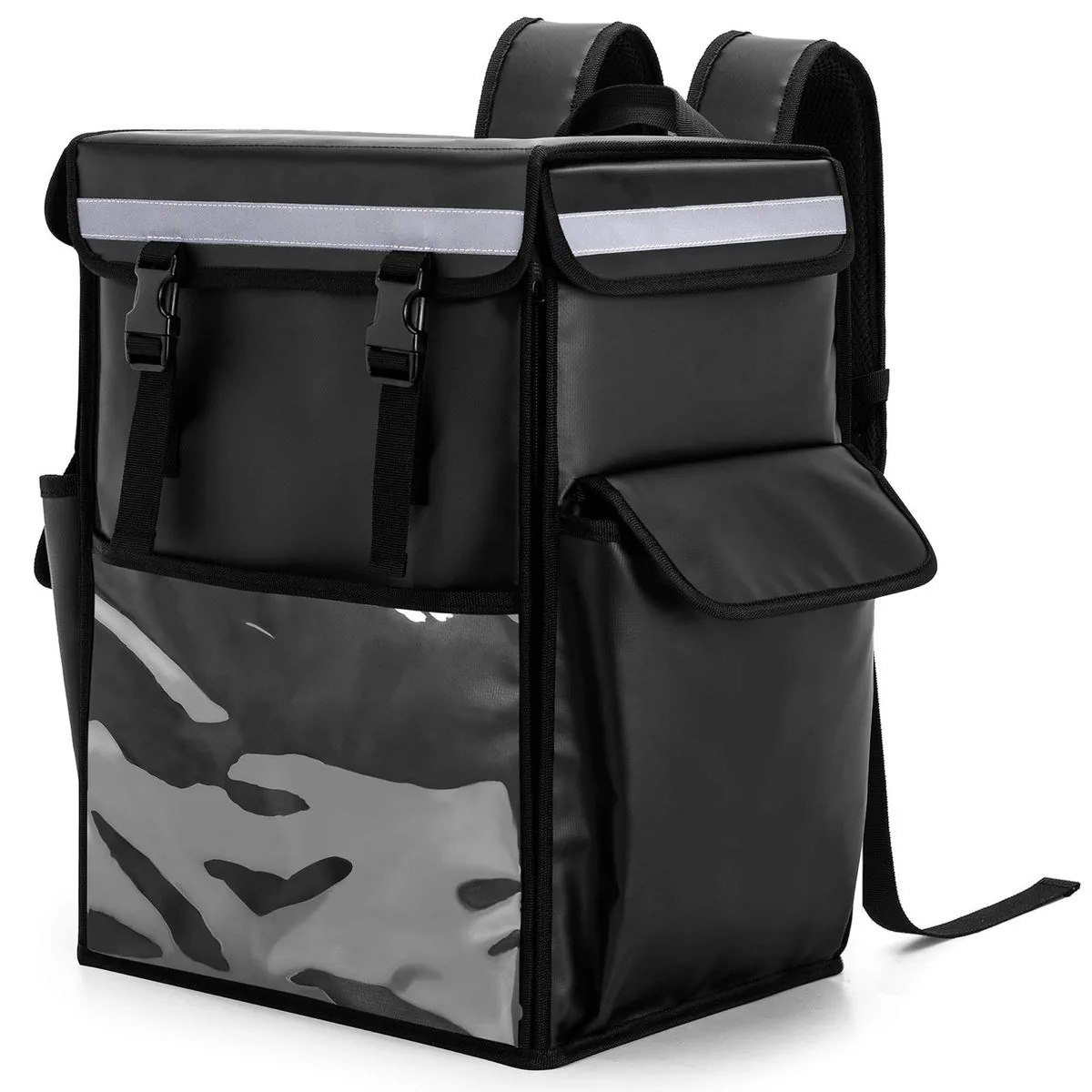
A delivery backpack is worn under load, often for a whole shift. The carry system has to be specified and then tested on the body, not only inspected on a table.
Shoulder straps. These are load-bearing parts. The published reference has padded, adjustable shoulder straps. Test them with a representative load. Watch the stitch line where each strap joins the body, at the top and at the lower attachment. Check that the length adjustment holds when the bag is full, and that the padding does not collapse into a thin edge on the shoulder.
A chest buckle keeps the shoulder straps from sliding outward when the rider moves. The published reference includes one. If your riders need it, write it into the brief and test it on the body with a full bag: buckle and unbuckle it with the load on, and walk or ride. Do not assume every delivery backpack includes one.
Reflective strips help the bag be seen in low light. They are not a substitute for the rider’s own lighting or garments. If they are part of the brief, confirm their placement on the sample, and check that they are still visible when the bag is worn and when the front panel is used for a logo.
A name-card window is a small front pocket or window for a rider or vehicle card. The published reference includes one at the top of the front. If you need it, say what size card must fit, and check that it can be inserted and read when the bag is closed.
Branding the fleet panel without weakening the bag
A delivery backpack often carries a fleet or restaurant mark on a large front panel. That panel is a branding surface and also part of the bag’s structure. Choose a decoration method that suits the actual shell, and confirm it on the sample.
Write into the brief: the artwork, the method (for example a printed panel, a sewn patch, or another route that the shell can accept), the placement, and how the mark should look after the bag has been opened, closed and wiped. On the sample, check that the logo does not sit over a zipper track, a window, or a stitch line that will be stressed, and that the front opening still works.
Any marks on our sample bags are placeholders. We replace them with your artwork.
Published reference construction you can start from
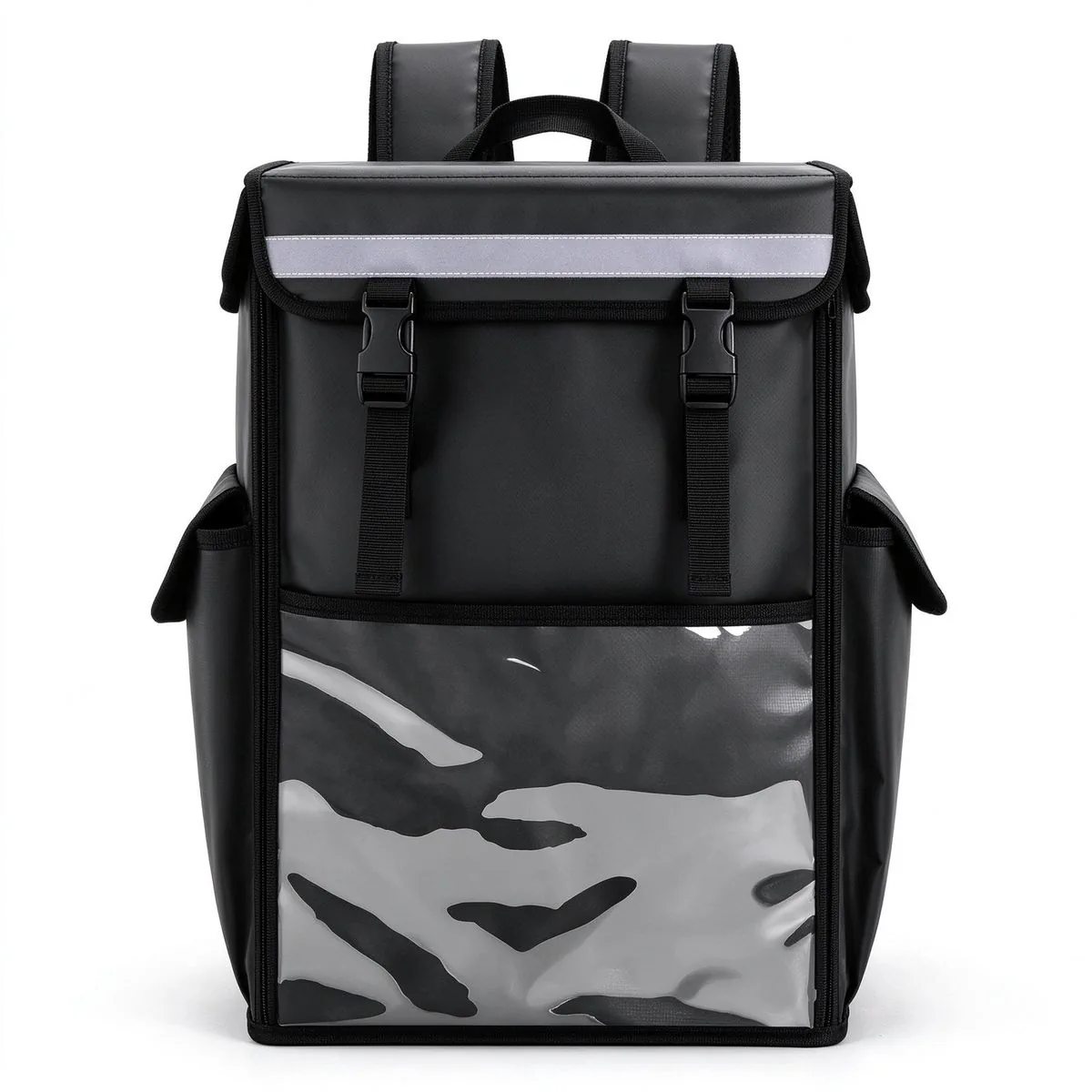
The model below is the delivery backpack published on this website. It is a starting point. Interior layout, insulation, materials, color, branding and packing are confirmed before sampling. If you need a style that is not shown here, send a photo or sketch and we will work out the construction before sampling.
Insulated food delivery backpack — Fleet delivery series. See the Insulated Food Delivery Backpack with Top and Front Opening (YS-DL01). It is a large delivery backpack, 37.1 × 26.9 × 48 cm (14.6 × 10.6 × 18.9 in), with a water-resistant heavy-duty outer shell, PE foam insulation and a wipe-clean aluminum-foil lining, top and front openings, a three-section main compartment with removable dividers and two support boards, reflective strips, padded shoulder straps, a chest buckle, a name-card window, and a large front panel for a fleet or brand logo. Water-resistant is not waterproof; if you need a specific rain performance, describe it in practical terms and confirm it on the sample. Custom colors, logo and packaging can be developed.
A picnic cooler, an insulated lunch bag, and a laptop backpack are different briefs. They are not substitutes for this construction. See the short comparison below, and the cooler bag guide, the insulated lunch bag guide, and the backpack guide for those forms.
What to lock in writing before a sample is made
- The route and the load, including the actual containers and whether hot and cold items share the bag.
- Openings. Top, front, or both; how a packed zipper must run; how a rider reaches one item without emptying the bag.
- Interior. Number of sections; removable dividers; support boards; how the stack must sit in a turn.
- Insulation and lining. The insulation build; a wipe-clean lining; any food-contact or market requirement, confirmed on the sample.
- Carry system. Padded shoulder straps; a chest buckle if you need one; how the loaded bag will be tested on the body.
- Visibility and cards. Reflective placement if required; a name-card window and the card size if required.
- Shell, color, branding and packing. The shell; any water-resistance expectation, described in practical terms; logo method and placement on the front panel; labels and export or fleet packing.
Sample review checklist
Use the intended containers, not a smaller substitute. Wear the bag; do not only inspect it on a table.
- Measure the bag at the agreed points and compare it with the specification.
- Load the real containers in the agreed stack. Close every opening.
- Tilt and walk with the packed bag as a rider would. Watch whether boxes slump, drinks lean, or a board shifts.
- Open the top and the front with the bag packed, including as it would be worn. Check that zippers run and that one item can be taken out without collapsing the stack.
- Remove and re-insert dividers and support boards. Confirm they fit the brief and do not scrape the lining.
- Wipe the lining at seams and corners, and look for peeling or cracking at fold lines.
- Put the bag on, adjust the straps, and walk with the representative load. Watch the strap joins, whether the length adjustment holds, and whether a chest buckle — if specified — can be used with the load on.
- Check reflective strips and the name-card window as they will be used, with the bag worn and closed.
- Check logo, color and labels against artwork and swatches in consistent light. Write one numbered comment list. Mark each item: accept, revise, or ask us for a suggestion.
The custom bag RFQ checklist has a method for comparing two quotes and freezing an approval reference. If material evidence is required for the destination market, how to read bag material reports explains how to match a report to a specific component rather than treating one sample report as a claim about every bag.
What to send with the first inquiry
- The route (bicycle, scooter, motorcycle or on foot) and how the bag will be worn
- The intended load, with container sizes if you have them
- Whether you need top access, front access, or both
- Interior needs (sections, dividers, support boards)
- Target quantity and destination market
- Preferred materials and colors, if known — or say that these are still open
- Any water-resistance or food-contact expectation
- Logo artwork and preferred decoration method
- Packing needs and target date
- Reference photos, a tech pack, or a physical sample
Submit these on the inquiry form and choose Delivery backpack as the product type. The form accepts JPG, PNG, WebP or PDF attachments. If the same inquiry also covers a matching cooler or lunch bag, say so in the message.
A delivery backpack is not a picnic cooler, a lunch bag, or a laptop pack
A picnic cooler is packed once and carried to a table. An insulated lunch bag is a smaller, daily meal bag. A laptop backpack is a carry system for a computer and a day’s office load; it is not built to hold stacked food containers on a ride. If the job is rider or fleet food delivery, specify it as a delivery backpack and test it with the real containers. Use the other guides when the brief is actually one of those other bags.
If you are ready to brief a factory
Dongguan Yishu Handbag Products Technology Co., Ltd. is a direct OEM/ODM bag factory in Dongguan, China. The model above is a reference style. A style that is not shown can be developed from your design, sample or tech pack.
The reference MOQ is 500 pieces per confirmed configuration. Special material, hardware or multiple colorways may change the final MOQ. Bulk production is typically 15–20 days, confirmed per order after sample approval, material review and order confirmation. Programs are planned to move through the six checkpoints on the quality page: requirement review, material check, pre-production sample, in-line inspection, final inspection, and packing release.
If you would like a delivery-backpack construction reviewed for your program, send the intended load, a reference and the target quantity through the inquiry form, or write to sales@yishubags.com. We will usually reply with a clearer specification and a sample plan.