Start with sample identity
Match the report number, applicant, sample description, color or component and issue date to the material being proposed. A test on a brown plastic zipper sample does not establish the result of another zipper supplier, a different color or the finished bag. Ask how the tested sample maps to the bill of materials for your project.
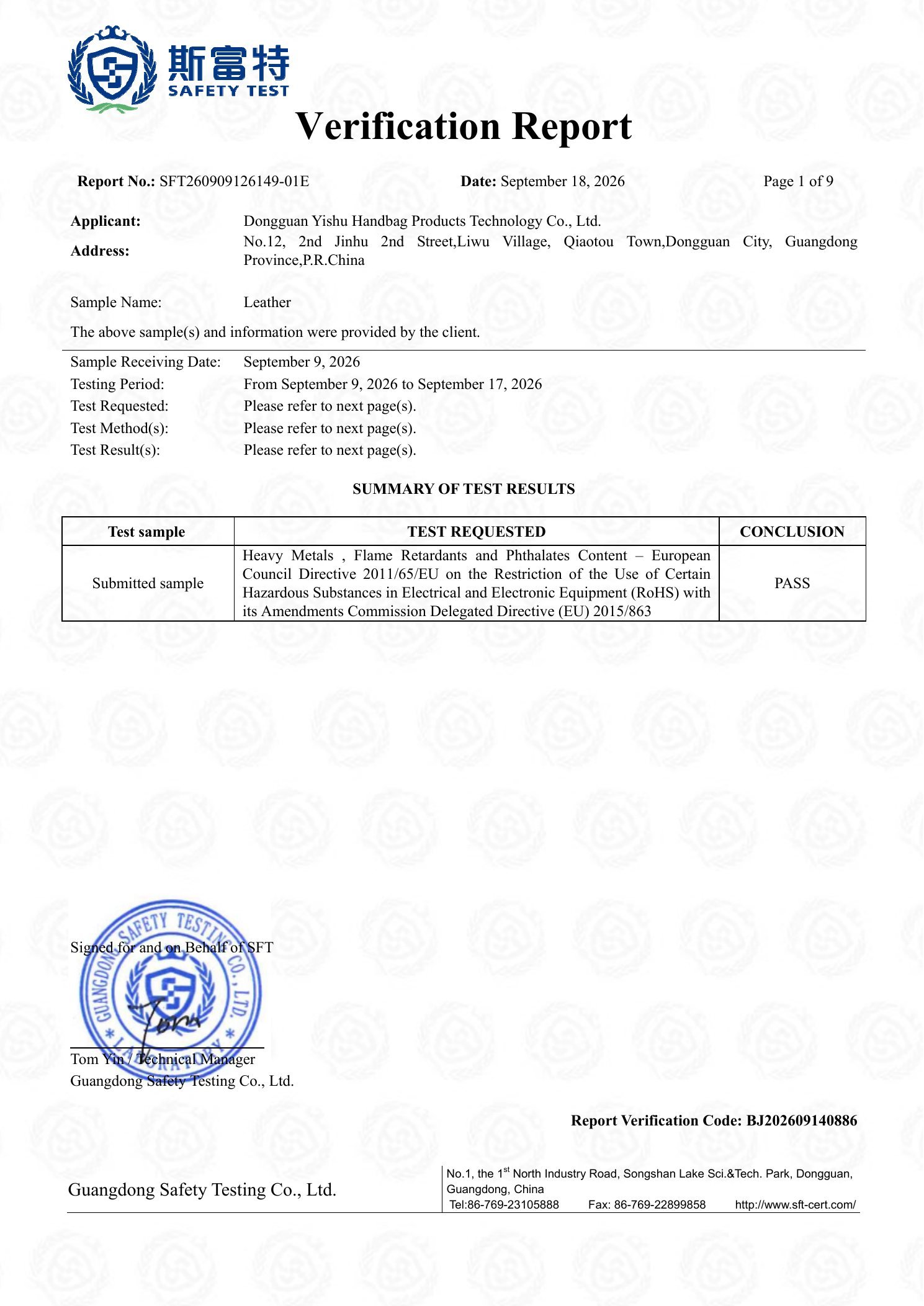
Our quality page shows selected page images from four submitted components: leather, lining fabric, zipper teeth and metal logo hardware. The excerpts are evidence for those samples, not a blanket certificate for all products.
Map the evidence to the component list
The submitted reports are dated September 18, 2026. Use their identifiers as a traceability starting point, then verify that the proposed production component actually matches the tested sample:
- SFT260909126149-01E: brown leather sample. The report's sample description is not a specification for every leather color or supplier.
- SFT260909126149-02E: grey fabric sample used for lining. Confirm whether the project's lining is the same material and color.
- SFT260909126149-03E: brown plastic sample identified as zipper teeth. A zipper assembly also includes other materials and hardware.
- SFT260909126149-05E: metal logo hardware sample, tested for salt-spray performance rather than substance content.
Create a simple component-to-report list for the proposed bag: outer material, lining, zipper tape and teeth, puller, buckles, coating, ink or print, foam, thread and any metal logo. Put no matching evidence yet beside an item without a relevant report. This avoids turning four reports into an unsupported whole-bag claim.
Read the method and the actual result
Identify the substance or performance property, referenced method, reporting limit and result. For substance tests, “not detected” does not mean absolute zero; it means the value was below that method's stated detection or reporting limit. For a performance test, check conditions and grading basis, not only the headline conclusion.
- Sample: Is this the same fabric, coating, color and component supplier proposed for the order?
- Method: Which standard and edition were used, and what does the method measure?
- Result: What is the measured value or rating, and what reporting limit applies?
- Requirement: Which buyer, market or product requirement was the result compared against?
- Timing: Was the report issued for the current material batch or an earlier reference sample?
- Coverage: Which materials in the finished bag remain untested?
On the submitted leather, fabric and zipper-plastic results pages, Pb, Cd, Hg, Cr and Br are shown as BL in the EDXRF screening table; DBP, BBP, DEHP and DIBP are shown as ND in the phthalates table. The report defines BL as below its screening limit and ND as below the method detection limit. These are different labels; neither says that the substances are mathematically absent. The report also notes that XRF is a primary screen and recommends follow-up chemical testing when a warning value is exceeded.
Keep EU claims precise
Some submitted component reports compare measured substances with limits referenced by EU RoHS 2011/65/EU and (EU) 2015/863. RoHS is a directive for electrical and electronic equipment. A component passing those referenced limits does not make every bag “RoHS certified” or prove that every material meets every EU market requirement. The conclusion belongs to the particular tested sample, substances and report.
For a new bag program, define the destination market, product type and buyer specification first. Then decide which components need evidence and whether current reports are suitable or new testing is required. A sales caption cannot replace a complete report and component-to-product trace.
Useful wording for a buyer file is: “The submitted brown leather sample in report SFT260909126149-01E was reported PASS for the listed substances against the referenced limits.” Avoid changing this to “all our bags are EU certified.” The first sentence can be checked against a named sample and report; the second cannot be established by those pages.
Salt spray answers a different question
A salt spray result concerns corrosion resistance under the stated test conditions. The published hardware extract records a 24-hour exposure with no visible rust and an RP 10 rating for the submitted metal logo sample. It is not a chemical substance screen and does not establish outdoor lifetime in all environments. Hardware finish, supplier and production lot should still be checked against the agreed requirement.
The method is listed as EN ISO 9227:2022, with a 5% sodium-chloride solution and a 35°C chamber. If another supplier quotes “salt-spray tested hardware,” ask for the exposure period, test solution, rating method and exact item photographed before and after. A 24-hour result and a longer-duration requirement cannot be treated as equivalent.
What to request before approval
- A readable complete report, not only a cropped PASS graphic.
- The report number and sample description matched to the approved material list.
- Test methods, limits and pages with measured results.
- A statement of which components or colors the evidence does not cover.
- A plan for additional testing required by the market or retailer.
- The version of the bill of materials and approved sample to which each report is linked.
- A retest decision if color, coating, supplier or construction changes after sample approval.
Use this list together with the custom bag inquiry checklist. Raise market and testing requirements before sampling instead of discovering a mismatch after bulk materials are booked.