# The briefing mistakes that delay a custom jewelry organizer order
A jewelry organizer has a specific job: keep rings, earrings, necklaces or a watch in place, then open cleanly when the owner needs them. When a brief treats it like a generic pouch or a toiletry bag, the first sample often answers the wrong questions, and a revision cycle follows that could have been avoided.
The mistakes below are the ones we see most often on custom jewelry organizer programs. They use two published reference models from our Dongguan factory — a folding pouch and a compact zip-around case — and the checks that actually change a quote and a sample.
Treating it as a toiletry bag, or as an empty pouch
A hanging toiletry bag or a mesh cosmetic bag is built to hold bottles, jars or brushes. Those products need openings, visibility or hang points. A jewelry organizer needs zones that hold individual pieces so they do not slip, catch or tangle.
If the brief only says “a small zip pouch for travel,” the factory still has to guess whether you need ring rolls, an earring grid, necklace clips, a watch pillow, or a simple open pocket. That guess shows up in the first sample. If the program is actually a toiletry or makeup bag, start from those reference pages. If it is a jewelry organizer, name the pieces it must hold.
Choosing the silhouette before you name what goes inside
Folding pouches and zip-around cases are not interchangeable. They can look similar in a photograph and still behave differently in a suitcase or a gift box.
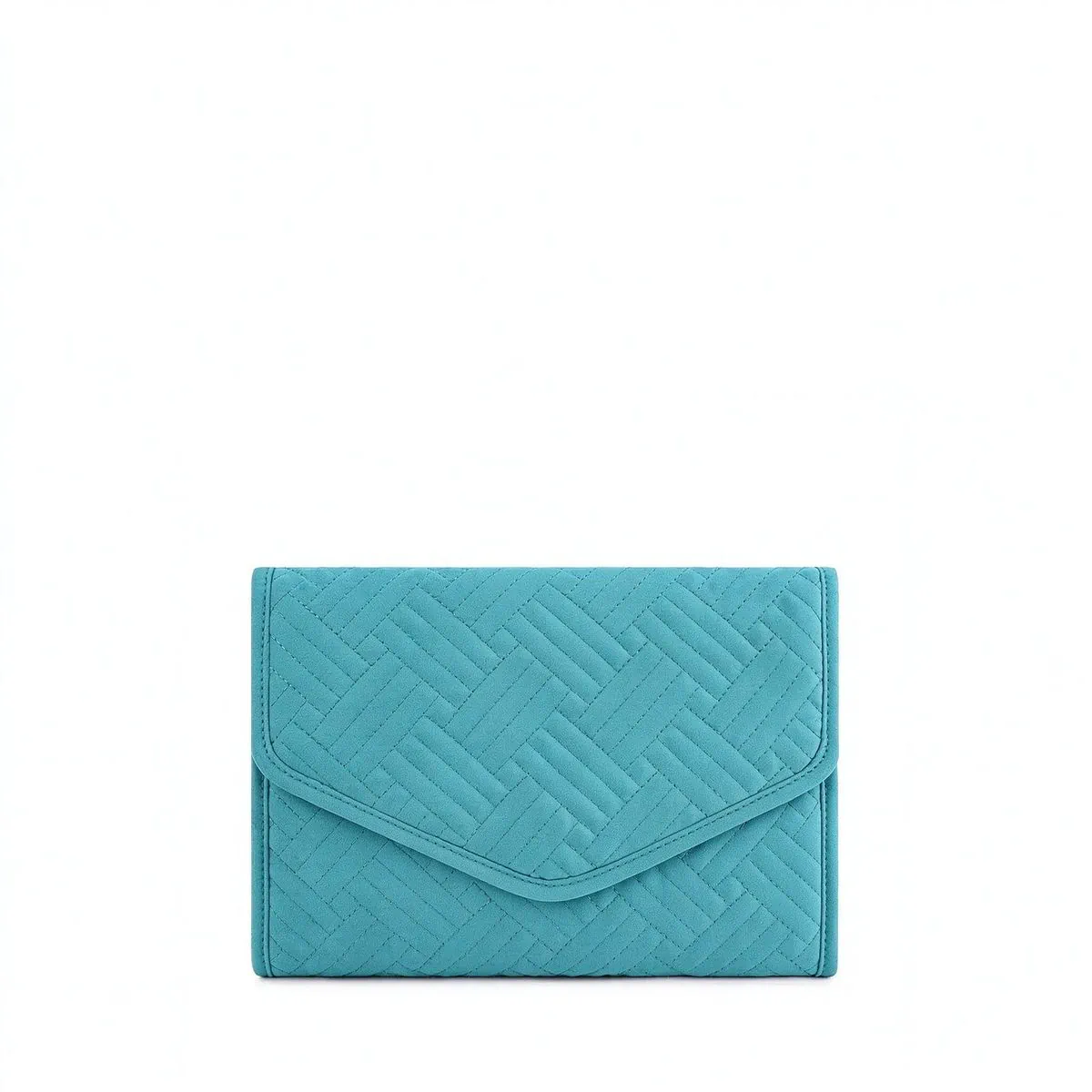
The published quilted folding jewelry organizer pouch (YS-JW01) packs flat. Folded, it measures 15.5 × 14 × 1.5 cm and weighs 0.118 kg. A magnetic envelope flap closes the bag; opened out, it becomes a zoned tray with two ring rolls for rings and bracelets, an earring grid, a clear zip pocket and necklace clips. The exterior on the live product page is chevron-quilted cotton. Colors and logo are made to your specification.
The published small zip-around jewelry case with watch pillow (YS-JW02) is a lightly padded, structured shell with rounded corners. A zip-around closure opens wide. Inside are five zones: a lid slip pocket with a necklace keeper, ring rolls, an elastic strap, an earring panel, and a base compartment with a watch pillow. It measures 12.7 × 7.6 × 5.7 cm, weighs 0.057 kg, and has a published approximate capacity of 0.55 L. The shell is polyester; the lining is soft microfiber, which the product page notes helps protect polished surfaces.
Choose the form from the job. A flat-pack travel pouch and a stand-up case with a watch pillow are different starting points. If the line needs both, say that up front so color, logo placement and gift packaging can stay consistent.
Leaving the lining, closure and failure points unsaid
A photograph is not a materials specification. The folding pouch page lists a quilted cotton exterior; it does not, on its own, freeze the lining. If the lining matters — because it will sit against polished metal, pearls or a watch crystal — write that requirement into the brief and confirm it on the specification and the sample. Do not assume one model’s lining is used on the other.
The same applies to closures. A magnetic flap has to stay closed when the pouch is packed. A zip-around opening has to run smoothly when the case is filled, not only when it is empty. State how the organizer will be carried (handbag, suitcase, gift box) and which failures would make it unsellable: rings slipping off a roll, earrings catching, necklaces tangling, a flap that springs open, or a lining that marks a polished surface.
If you have a buyer or retailer material requirement, include it. Any testing should be planned for the actual materials and the destination market, not inferred from a product photo.
Approving a sample that was only looked at, not packed
An empty jewelry organizer can look neat and still fail in use. Review the pre-production sample with representative jewelry, not only with empty pockets.
Measure the sample at the agreed points — folded and open if it is a folding pouch — and compare those numbers with the specification. Place the actual rings, earrings, necklaces or watch in the agreed zones, close the flap or zipper, and move the packed organizer the way it would move in a bag or suitcase. Then open it and check whether pieces stayed in place and whether chains tangled.
Work the closure several times when the case is filled. Check logo position, color and labels against artwork and a swatch in consistent light. Put every comment on one numbered list, and mark each item accept, revise, or factory to advise. Comments split across chat threads are a common reason a second sample still misses a change.
Leaving gift packaging until the bag is already approved
Many iewelry programs are sold as gifts or in retail sets. Gift packaging can be specified on both published reference models: a custom gift box, and on the folding pouch page, a gift pouch as well. That packaging is part of the program, not an afterthought.
If a gift box, sleeve, insert or pouch is required, include it in the first inquiry: how it relates to the organizer, where the logo sits, and whether the box is shown on a shelf or used only for fulfillment. Review the packaging with the organizer inside, not only the bag on its own. A late packaging change can still affect timing and the packing specification, even when the bag itself fits the brief.
The reference starting minimum is 500 pieces per confirmed configuration. A special material, a custom hardware item, or a split across several colors may change that minimum. Bulk production is typically 15–20 days after sample approval, material review and order confirmation, which is why the bag and the packaging should be frozen together.
What a usable first inquiry actually includes
You do not need a complete tech pack to start, but you do need enough for a factory to quote and sample the same product you have in mind. At minimum, send:
- The pieces the organizer must hold, and whether it is for travel, everyday use, or a gift set
- Preferred form, if you have one — folding pouch, zip-around case, or both in one line — or say that this is still open
- Target quantity, color split if known, and destination market
- Preferred exterior and lining materials, or a note that you want a suggestion
- Logo artwork and the decoration method you prefer, if already decided
- Whether gift packaging is required
- Packing needs and a target date
- A reference photo, a tech pack, or a physical sample
The custom bag RFQ checklist is a practical place to organize those points so two quotes can be compared on the same basis.
Ready to send a jewelry organizer brief?
Dongguan Yishu Handbag Products Technology Co., Ltd. is a direct OEM/ODM bag factory in Dongguan, China. The two jewelry organizers above are reference styles. A layout that is not shown can be developed from your design, sample or tech pack after review.
If you have a jewelry organizer brief, send it through our inquiry form, or email sales@yishubags.com with the pieces to be held, the target quantity and the destination market. We will tell you what can be quoted from that information, and what still needs a sample or a material confirmation.